Hans Haacke
“Like no other artist of his generation, Haacke shaped political art. His work, characterized by directness and theoretical clarity, is simultaneously poetic, metaphorical, ecological, and in many respects extremely contemporary. He consistently stands up for his convictions, which include, in particular, the defense of democratic principles.”
Ingrid Pfeiffer, Schirn Kunsthalle
A pioneer of conceptual art and institutional critique
Hans Haacke (born August 12, 1936 in Cologne) is considered one of the most influential and formative figures in the field of political conceptual art. His multifaceted work is characterized by a profound engagement with the conditions of art, power, and society.
Early works: Physical and Biological Systems
Haacke’s early work, particularly in the 1960s, focused on the investigation of physical and biological systems, as well as natural phenomena such as water, wind, and condensation . These works, often described as “system art,” utilized real, changing processes—for example, in closed ecosystems or through meteorological influences—to create aesthetic states that were not static but dynamic and process-oriented. By incorporating these invisible or difficult-to-control forces, Haacke addressed the relationality and interdependence of phenomena and questioned the traditional, object-centered conception of art.
Turning towards institutional critique and political engagement
However, the turning point in his career and the foundation for his international renown was his critical examination of the art world and the political and economic structures behind it. Haacke developed into one of the most important representatives of so-called institutional critique, an artistic practice that investigates and addresses museums, galleries, and other cultural institutions as economically and ideologically influenced spaces.
His politically and socially engaged works often illuminate the entanglements between art patronage, global politics, and corporate interests. Famous works such as Shapolsky et al. Manhattan Real Estate Holdings, a Real Time Social System, as of May 1, 1971 (1971), which exposed the real estate speculations of a New York entrepreneur, or the interventions that critically examined the sponsors of art exhibitions, made him an uncomfortable but indispensable commentator on contemporary society.
Life and work
Since 1965, Hans Haacke has lived and worked permanently in New York City, from where he steadily expanded his influence on the international art scene and inspired generations of conceptual artists. His work, which consistently blurs the boundaries between aesthetics and ethics, art and political activism, remains a central point of reference for all those who critically examine the social and institutional frameworks of art.
1956–1960: Hans Haacke studied at the State Academy of Fine Arts in Kassel (today’s Kassel School of Art and Design).
1959: He worked as a student trainee at documenta 2 and photographed the visitors in front of the artworks ( Photo notes, documenta 2 ).
1960–1962: He received a scholarship from the German Academic Exchange Service (DAAD) for a one-year stay in Paris at Stanley William Hayter’s Atelier 17 , as well as a Fulbright scholarship for the Tyler School of Art at Temple University in Philadelphia.
1962: This year he moved to New York City and exhibited his work there. He participated for the first time in an exhibition of the Düsseldorf group ZERO (NULL 1962 ) at the Stedelijk Museum Amsterdam, where he showed Plexiglas works and reliefs. Haacke participated in a total of ten ZERO group exhibitions until 1965.
Hans Haacke worked as a lecturer and later as a professor at the Cooper Union for the Advancement of Science and Art in New York City from 1967 to 2002 .
Exhibitions & Projects
Haacke exhibits in important institutions worldwide, including a total of five times at documenta in Kassel between 1972 and 2017.
A selection of important solo and group exhibitions, as well as participation in biennials:
1962: ZERO 1962 took place at the Stedelijk Museum in Amsterdam, Netherlands. This was an important participation in the group exhibition of the artists’ group ZERO.
1965: Wind and Water was Haacke’s first solo exhibition in Germany and was shown at the Schmela Gallery in Düsseldorf.
1970: Information was a group exhibition at the Museum of Modern Art (MoMA) in New York, USA, for which Haacke developed the critical MoMA Poll .
1971: A planned solo exhibition at the Solomon R. Guggenheim Museum in New York, USA, was cancelled at short notice because the institution refused to present the work “Shapolsky et al. Manhattan Real Estate . ”
1972: Haacke participated in documenta 5 in Kassel, Germany.
1972: In a solo exhibition at the Museum Haus Lange in Krefeld, Germany, he presented the installation “Rhine water treatment plant” .
1978: He had a solo exhibition at the Museum of Modern Art in Oxford, Great Britain.
1979: A solo exhibition took place at the Stedelijk van Abbemuseum in Eindhoven, Netherlands.
1981: At the exhibition Westkunst – Contemporary Art since 1939 in Cologne, Germany, Haacke presented “The Chocolate Master” , a critical work about the collector Peter Ludwig.
1982: He participated in documenta 7 in Kassel.
1984: The solo exhibition ” According to all the rules of art” was shown at the Neuer Berliner Kunstverein (nbk) in Berlin, Germany.
1986: Unfinished Business was a comprehensive retrospective at the New Museum of Contemporary Art in New York, USA.
1987: Participation in documenta 8 in Kassel
1988: Haacke had a solo exhibition at the Tate Gallery, London, Great Britain.
1993: At the Venice Biennale in Italy, Hans Haacke and Nam June Paik received the Golden Lion for their contributions to the German Pavilion. Haacke’s radical installation “Bodenlos” (Bottomless), known as Germania, which was realized in the central main hall of the pavilion, has repeatedly served as a direct or indirect point of reference for subsequent artists working in this symbolically significant location.
1997: Participation in documenta 10 in Kassel
2001: “Mia san Mia” , solo exhibition at the Generali Foundation in Vienna, Austria
2006: Wirklich – Werke 1959–2006 was a large, two-part retrospective that took place simultaneously at the Deichtorhallen Hamburg and the Akademie der Künste Berlin.
2006: Rosa Luxemburg Monument : Ground sculpture on Rosa Luxemburg Square in Berlin Mitte. Text quotations from Rosa Luxemburg’s work, mounted in the ground, extend across all traffic areas of the entire square.
2012: A retrospective was presented at the Museo Reina Sofía in Madrid, Spain.
2015-2017: As part of the Fourth Plinth Commission, he created the public artwork “Gift Horse” in Trafalgar Square in London, Great Britain.
2017: Participation in documenta 14
2019: With All Connected at the New Museum of Contemporary Art in New York, Haacke’s work is presented for the first time in the USA in a comprehensive institutional overview spanning six decades.
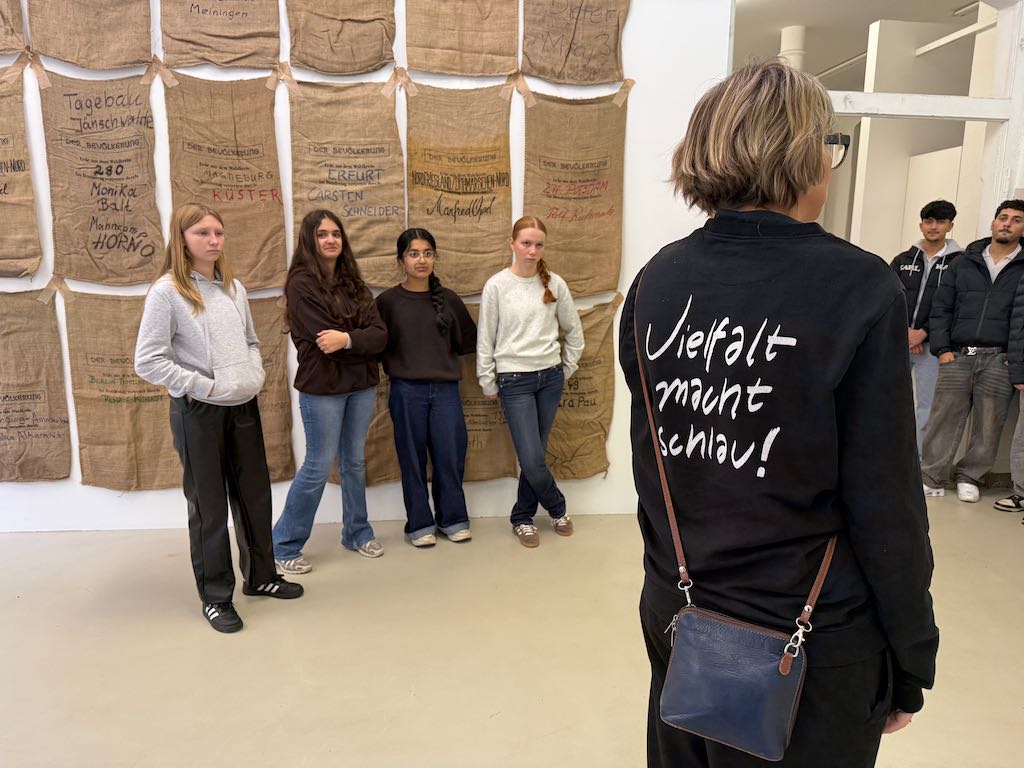
2024–2025: The Hans Haacke Retrospective, presented at the Schirn Kunsthalle in Frankfurt am Main and subsequently at the Belvedere 21 in Vienna, honors Haacke’s complete works from 1959 to the present. The extensive documentation ” 25 Years of THE POPULATION” forms the concluding theme of the Frankfurt museum exhibition and simultaneously forges a link to our current political landscape.
Honors
1991: Honorary doctorate from Oberlin College in Ohio
1993: Golden Lion (Venice Biennale, together with Nam June Paik)
1998: Honorary doctorate from the Bauhaus University Weimar
2004: Peter Weiss Prize of the City of Bochum
2006: Roland Prize for Art in Public Space
2008: Honorary doctorate from the San Francisco Art Institute
2017: Roswitha Haftmann Prize
2019: Arnold Bode Prize
2020: Goslar Kaiserring